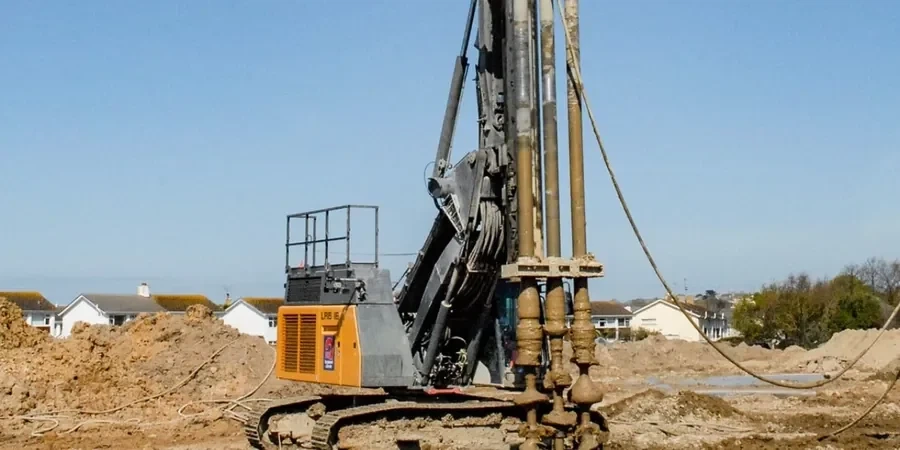
We were called to a site near the Santa Ana River where a 10-story residential tower was planned over 40 feet of soft, saturated silty clay. Standard driven piles would have required costly predrilling and created vibration issues for adjacent historic buildings. Instead, we designed a deep soil mixing (DSM) grid to improve the native soil in situ, reaching a target unconfined compressive strength of 150 psi. The columns were installed in a triangular pattern, with overlapping secant elements forming a block that distributes loads evenly. Before the DSM design, we ran a [MASW survey](/masw-vs30/) to map shear wave velocity variations across the site, which helped us optimize column spacing. That project saved the owner roughly 30% in foundation costs compared to deep pile alternatives.
We treat Riverside’s soft alluvial soils in situ, creating stiff DSM columns that cut foundation costs by up to 30% versus deep piles.
Method and coverage
Riverside sits on a deep alluvial basin with alternating layers of sand, silt, and clay deposited by ancient floodplains. The city grew fast in the post-war building boom, and many older structures rest on shallow footings that now need underpinning as redevelopment adds weight. For new construction, DSM offers a practical solution: it creates stiff, low-permeability columns that reduce total and differential settlements under heavy loads. In a recent warehouse expansion in the Hunter Industrial Park, we treated a 60,000 sf footprint with DSM columns reaching 55 feet depth. The design used a binder ratio of 12% cement by dry weight, verified by field wet-grab samples taken every 50 columns. Combining DSM with vertical drains accelerated consolidation of the intervening soft clay, while geotextile reinforcement at the base of the working platform improved stability during construction. The columns were tested by coring and unconfined compression at 28 days, all exceeding the design minimum of 120 psi.
Technical reference image — Riverside
Regional considerations
Riverside’s Mediterranean climate brings dry summers and episodic winter storms that can raise the water table by several feet within days. In low-lying areas near the Santa Ana River, the phreatic surface sits just 3 to 6 feet below grade during wet months. Saturated loose sands become prone to liquefaction under seismic loading — Riverside is in Seismic Design Category D per ASCE 7. DSM mitigates this by densifying the soil matrix and adding cementitious bonds that resist cyclic shear. We always verify the post-treatment vs30/" data-interlink="1">shear wave velocity with crosshole testing to confirm liquefaction resistance meets IBC requirements. The risk of untreated soil under a heavy structure is differential settlement that cracks slabs and misaligns elevator shafts; DSM avoids that by creating a monolithic treated block.
For heavy structures like mid-rise buildings and bridge abutments, we design a grid of overlapping columns that form a rigid block extending through soft layers to competent bearing strata. Includes field verification by coring and UCS testing, plus settlement analysis under working loads.
02
Perimeter DSM walls for excavation support
When Riverside’s high water table requires cut-off walls during basement excavation, we design secant DSM panels that act as both earth retention and groundwater barrier. Panels are installed in continuous overlapping rows, with tiebacks if needed for deeper cuts.
Standards that apply
ASCE 7-22 (Seismic Design Category D), IBC 2021 (Chapter 18 – Soils and Foundations), FHWA-HRT-13-046 (Deep Mixing for Embankment and Foundation Support), ASTM D1586-18 (Standard Penetration Test for Soil Classification)
Q&A
What soil conditions in Riverside are best treated with DSM?
Soft saturated clays, loose silty sands, and organic alluvial deposits typical of the Santa Ana River floodplain respond well to DSM. Soils with a natural moisture content above 40% or SPT N-values below 5 blows/ft are prime candidates. We run a preliminary laboratory mix design to optimize binder type and dosage for each site’s specific gradation and plasticity.
How much does a deep soil mixing design cost in Riverside?
For a typical Riverside project, the design and field testing scope ranges between US$1,920 and US$6,570. This covers the preliminary lab mix design, structural analysis, column layout drawings, and field quality control including coring and unconfined compression tests. Costs vary with treatment volume and depth; we deliver a fixed-price proposal after reviewing site data.
How does DSM compare to jet grouting for Riverside soils?
DSM is generally more cost-effective for large treatment volumes because it uses a single rotating mixing tool that blends soil in place without high-pressure fluid injection. Jet grouting can reach higher strengths but creates more spoils and requires higher energy. For Riverside’s deep alluvial deposits, DSM typically achieves adequate strength (120–200 psi) at a lower unit cost.
What quality control tests do you perform on DSM columns?
We require wet-grab sampling during installation at a rate of one sample per 50 columns, cured and tested for unconfined compressive strength at 7, 14, and 28 days. After curing, we core at least 3% of columns and run UCS plus visual logging. For seismic projects, we also measure vs30/" data-interlink="1">shear wave velocity via crosshole tomography to confirm liquefaction resistance.