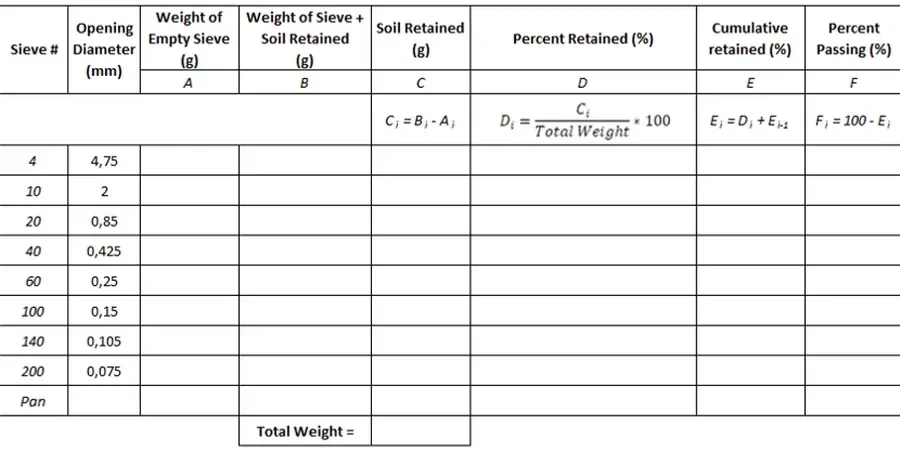
The alluvial fans of Riverside near the Santa Ana River deposit coarse sands and gravels, while the historic Arlington Heights area features dense clays from ancient lakebeds. This sharp contrast in soil behavior makes a detailed grain size analysis indispensable before any foundation design. Without knowing exactly how much fines content a site has, engineers risk misclassifying the material — and that error can cascade into settlement predictions or compaction specifications. A proper sieve and hydrometer test separates these fractions with precision, giving the design team the data they need to apply the Unified Soil Classification System correctly. Many local projects also require cross-referencing particle size curves with Atterberg limits to fully characterize plasticity, especially when dealing with the expansive clays found in the La Sierra neighborhood.
A single missing sieve fraction can shift a Unified Soil Classification from SW to SM, changing the entire compaction and drainage approach.
Method and coverage
Riverside grew rapidly during the citrus boom of the early 1900s, and much of that development happened on undocumented fill placed over old streambeds. That legacy means today's geotechnical investigations must go beyond a simple visual classification. A full grain size analysis in Riverside involves dry sieving through a nested stack of ASTM sieves for the coarse fraction, followed by a hydrometer sedimentation test for particles smaller than 0.075 mm. The lab team records cumulative percent passing at each sieve and plots the gradation curve, which then feeds into permeability estimates and compaction control. When the site contains organic silts from former marshland near Fairmount Park, the test sequence is adjusted to remove organic matter before dispersion, and the results are paired with a Proctor compaction test to set realistic density targets for the fill placement.
Technical reference image — Riverside
Regional considerations
In Riverside, many times we see contractors assume a soil is well-graded just because it looks mixed at the surface. But a few feet down, the same borrow source may have segregated into clean sand lenses and clay pockets. Without a proper grain size analysis, the fill placement spec is wrong from the start. That leads to differential compaction, poor drainage, and eventually slab cracks or pavement failures. The risk is even higher in the Sycamore Canyon area, where colluvial slopes produce gap-graded soils that behave unpredictably under wetting cycles. A sieve and hydrometer test catches those gaps before the earthwork begins.
Dry or wet sieving through the full ASTM sieve stack for soils up to 3-inch particles. Includes washing on No. 200 sieve for accurate fines content. Results delivered as a gradation curve with D10, D30, D60 coefficients and uniformity/curvature indices.
02
Complete Gradation with Hydrometer (ASTM D7928)
Full sieve plus hydrometer sedimentation for soils containing more than 12% fines. Includes dispersion with sodium hexametaphosphate, timed readings at 20°C, and Stokes' law correction for particle density. Essential for fine-grained Riverside soils where the No. 200 sieve cannot separate clay from silt.
This service complements our laboratory testing work for a complete project analysis.
Standards that apply
ASTM D422-63 (2007) Standard Test Method for Particle-Size Analysis of Soils, ASTM D6913-17 Standard Test Methods for Particle-Size Distribution (Gradation) of Soils Using Sieve Analysis, ASTM D7928-21 Standard Test Method for Particle-Size Distribution (Gradation) of Fine-Grained Soils Using the Sedimentation (Hydrometer) Analysis, AASHTO T-88 Standard Method of Test for Particle Size Analysis of Soils
Q&A
What is the difference between sieve analysis and hydrometer analysis?
Sieve analysis separates particles by passing them through a stack of woven-wire sieves, working down to 0.075 mm (No. 200). Hydrometer analysis uses the sedimentation rate of particles in a water column to measure sizes below 0.075 mm, down to about 0.001 mm. For Riverside soils with significant silt or clay content, both methods are needed to obtain a complete gradation curve.
How much sample is required for a grain size analysis?
The required mass depends on the largest particle size present. For soils with particles up to 3/4 inch, about 500 g is sufficient. If the soil contains gravel up to 3 inches, the sample mass should be at least 2000 g. Our lab provides sample containers and collection instructions when you schedule the test.
How long does a complete grain size analysis take?
Standard turnaround is 5 to 7 business days from sample receipt. The sieve portion is completed within the first day, while the hydrometer sedimentation requires multiple readings over a 24-hour period. Rush service can be arranged for an additional fee if needed for critical submittal deadlines.
What is the typical cost range for grain size analysis in Riverside?
The cost for a standard sieve analysis typically ranges between US$90 and US$150 per sample. Adding the hydrometer component increases the price to between US$160 and US$220 per sample, depending on the number of required readings and the complexity of the soil matrix. Volume discounts apply for projects with multiple samples.