The semi-arid climate of Riverside, with hot summers and mild winters, creates distinct challenges for pavement and subgrade design. Annual rainfall averages around 10 inches, concentrated in winter storms. This pattern leads to cyclic wetting and drying of the subgrade soils, which are often derived from alluvial fans of the San Bernardino Mountains. Many local soils classify as silty sands (SM) or low-plasticity clays (CL) per the Unified Soil Classification System. These materials can lose bearing capacity rapidly when moisture content rises. A thorough road geotechnics study must therefore evaluate both dry density and saturated strength. For Riverside projects, we integrate field density testing with laboratory CBR analysis to simulate the worst-case moisture conditions that pavements will face during the rainy season.
For Riverside pavements, the resilient modulus of the subgrade can drop 40% when moisture rises above optimum — field CBR testing captures this critical loss.
Method and coverage
Riverside's post-war expansion transformed it from a citrus-growing hub into a major logistics corridor. The I-215 and SR-91 freeways now carry heavy truck traffic daily. This history means many existing pavements sit on compacted fill or reworked agricultural soils. The geotechnical challenge lies in distinguishing between native alluvium and man-made fill during investigation. Our approach for road geotechnics in Riverside combines dynamic cone penetration (DCP) testing with standard Proctor compaction curves. We also assess the California Bearing Ratio (CBR) for each soil stratum identified. When the subgrade shows high plasticity, we recommend stabilizing with lime or cement. This method reduces swell potential and raises the resilient modulus. The goal is to design a pavement structure that lasts 20 years despite the cyclic moisture and heavy axle loads typical of the Inland Empire.
Technical reference image — Riverside
Regional considerations
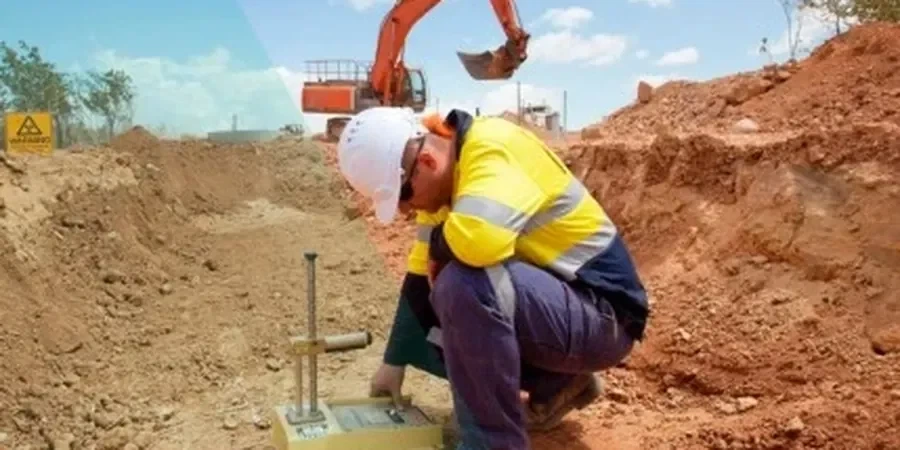
A mobile field CBR test rig travels to Riverside construction sites to perform in-situ bearing ratio tests directly on the subgrade. The equipment includes a calibrated hydraulic jack, proving ring, and penetration piston mounted on a flatbed truck. For Riverside's alluvial fans, we often encounter a thin desiccated crust overlying softer material. If the pavement design relies on the crust alone, the subgrade fails within months. The road geotechnics evaluation must therefore test at multiple depths — typically 0.15 m, 0.30 m, and 0.45 m below formation level. Ignoring the softer layer beneath the crust leads to differential settlement and pavement cracking. We also verify the compaction using a nuclear density gauge to ensure the subgrade meets the minimum 95% of maximum dry density specified by Caltrans.
Auger borings, test pits, and soil sampling to classify subgrade materials per USCS and AASHTO. Includes moisture-density relationships and swell tests for expansive soils.
02
CBR testing (field & laboratory)
In-situ CBR with mobile rig and laboratory soaked CBR per ASTM D1883. Results used to determine design CBR for flexible pavement thickness design.
03
Resilient modulus determination
Cyclic triaxial testing per AASHTO T 307 to obtain Mr values for mechanistic-empirical pavement design (MEPDG). Critical for Riverside's heavy truck routes.
04
Pavement structural design
Layer thickness calculations using Caltrans or AASHTO 1993 methods. Includes drainage analysis, frost protection (where applicable), and life-cycle cost estimates.
Standards that apply
ASTM D1883-21 (CBR for laboratory compacted soils), ASTM D698-12 (Standard Proctor compaction), AASHTO T 307-99 (Resilient modulus of subgrade soils), Caltrans Highway Design Manual — Chapter 630 (Pavement Structural Section)
Q&A
What is the typical CBR range for subgrade soils in Riverside?
Native alluvial soils in Riverside generally yield soaked CBR values between 5 and 15 at 95% Proctor density. Sandy materials near the Santa Ana River channel can reach 20, while clay-rich deposits from the Box Springs area may drop to 3-5. We always recommend soaked CBR testing because the winter rains can saturate the subgrade and reduce bearing capacity significantly.
How much does a road geotechnics study for a typical Riverside subdivision cost?
A full pavement subgrade investigation for a standard Riverside subdivision (10-20 test points) typically ranges between US$870 and US$4,600. The final cost depends on site access, number of borings, laboratory testing scope (CBR, Proctor, Atterberg limits), and whether resilient modulus testing is required. Contact our office for a site-specific quote.
What is the difference between CBR and resilient modulus for pavement design?
CBR is a static penetration test that measures shear strength under controlled moisture and density. Resilient modulus (Mr) is a dynamic test that simulates repeated traffic loading. Mr values are used in mechanistic-empirical design (MEPDG) and are typically 10 to 20 times the CBR value for fine-grained soils. For Riverside projects with heavy truck traffic, we recommend Mr testing to capture the subgrade's response under cyclic loading.