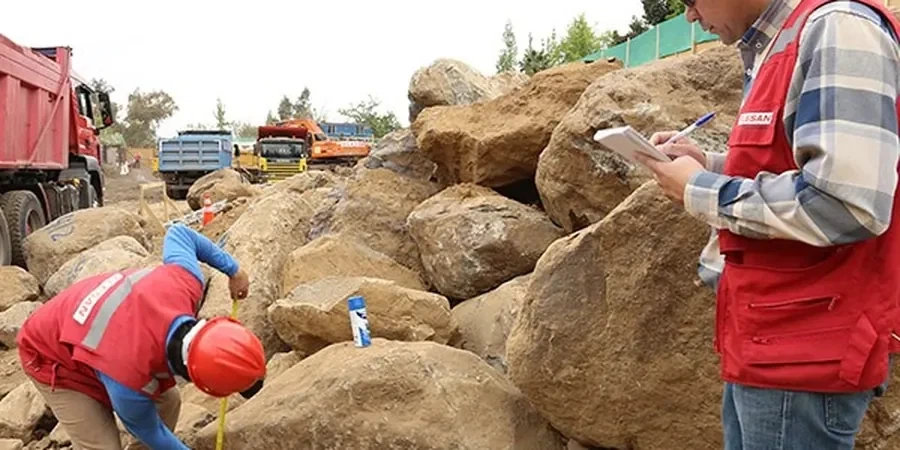
Riverside sits in a semi-arid inland valley where summer temperatures regularly exceed 100°F, baking the upper soil layers into a hard crust that can mask weaker conditions below. That thermal contrast means a shallow penetration test alone often overestimates stiffness, leading to foundation designs that crack or settle unevenly when winter rains arrive. The Flat Dilatometer Test (DMT) cuts through that crust to measure lateral stress, modulus, and consolidation behavior at depth. We deploy the DMT across Riverside to capture a continuous profile of the alluvial fan deposits and old river terrace soils that underlie most projects here. Combining DMT data with a seismic site response analysis helps us classify the ground properly under ASCE 7 for seismic design.
DMT profiles in Riverside often show a 30–40% lower modulus in the first 5 meters than SPT correlations would predict, especially after wet seasons.
Method and coverage
A common mistake we see in Riverside is relying solely on SPT N-values for spread footing design. The blow count can look good in the desiccated crust, but the dilatometer often reveals a softer layer just a few feet down. The DMT measures the horizontal stress index (KD), which directly relates to overconsolidation ratio and lateral earth pressure. That data is essential when you are designing retaining walls or braced excavations in Riverside's old river channels. We run the test according to ASTM D6635-15, pushing the blade at 2 cm/s and taking readings every 20 cm. For projects near the Santa Ana River, we pair the DMT with instrumentation and monitoring to track long-term pore pressure changes in the alluvial silts.
Technical reference image — Riverside
Regional considerations
IBC 2021 and ASCE 7-22 require site-specific seismic ground motion parameters, which depend on the vs30/" data-interlink="1">shear wave velocity profile and soil stiffness. In Riverside, the California Geological Survey maps several liquefaction-prone zones along the Santa Ana River floodplain and the old Arlington Canal corridor. A DMT profile identifies the soft, potentially liquefiable layers by measuring low ED values and high KD in loose saturated sands. Without that data, you risk underestimating settlement or lateral spread during a seismic event. The test also helps assign the correct Site Class (C, D, or E) for the building code design spectrum.
One DMT push to 15 m depth with readings every 20 cm. Includes field logs, ED, KD, ID profiles, and a summary report with estimated OCR and K0. Ideal for single-family homes or small additions in Riverside's established neighborhoods.
02
Advanced DMT with Seismic Module (DMT-S)
Adds a seismic receiver to measure vs30/" data-interlink="1">shear wave velocity (VS) at 1 m intervals during the sounding. Combines DMT stiffness with VS for Site Class determination per ASCE 7. Recommended for commercial buildings or schools in Riverside.
03
DMT for Lateral Earth Pressure Design
Extended push to 25 m with emphasis on KD and K0 profiles for shoring, tieback anchors, and basement wall design. Includes interpretation for at-rest and active pressure conditions. Common for underground parking structures in downtown Riverside.
Standards that apply
ASTM D6635-15 – Standard Test Method for Performing the Flat Plate Dilatometer, IBC 2021 Chapter 18 – Soils and Foundations, ASCE 7-22 Chapter 20 – Site Classification Procedure for Seismic Design
Q&A
How does the Flat Dilatometer Test differ from the SPT in Riverside soils?
The DMT measures lateral stress and stiffness in situ without the dynamic disturbance of hammer driving. In Riverside's desiccated crust, SPT N-values can be misleadingly high, while the DMT reveals the actual modulus and overconsolidation profile. The DMT also gives a continuous log, not just data at 1.5 m intervals.
What does a DMT cost in Riverside?
A standard DMT sounding runs between US$910 and US$940 for a 15 m push, including field work and a basic interpretation report. Costs scale with depth, additional seismic module readings, and the number of test locations. Contact us for a site-specific quote.
Can the DMT help with liquefaction assessment in Riverside?
Yes. The DMT's KD profile correlates well with cyclic resistance ratio (CRR) for liquefaction triggering. Low ED values paired with high KD in loose saturated sands indicate potential for liquefaction. This is especially relevant in Riverside's Santa Ana River floodplain and near the old canal alignments.
How deep can the DMT blade reach in Riverside's alluvial soils?
Typically 15 to 25 m in Riverside's silty sands and lean clays. The rigid blade can encounter refusal in dense gravel layers or cemented caliche horizons common in the older terrace deposits. We pre-drill through any hard cap if needed to reach the target depth.
Do I need a DMT if I already have SPT borings on my Riverside site?
It depends on your design needs. If you are designing a shallow foundation or retaining wall, the DMT provides better estimates of settlement and lateral earth pressure than SPT correlations. For seismic site class, the DMT with seismic module gives VS directly, while SPT-based correlations are less reliable in Riverside's variable alluvium.