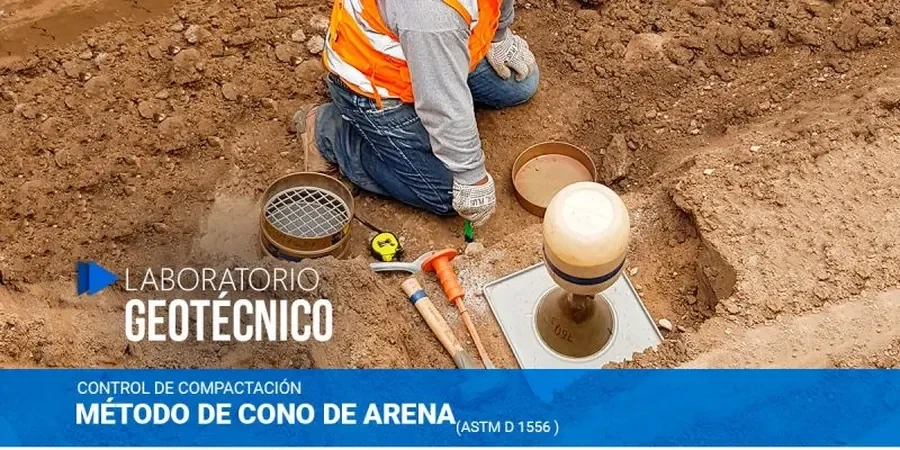
In Riverside, where much of the development sits on deep alluvial fan deposits from the San Bernardino Mountains, meeting compaction specifications under IBC 2021 and ASTM D1556-16 is non-negotiable. The sand cone method remains the most reliable field test for verifying dry density and moisture content on site, especially when the contractor is placing engineered fill for structural pads or roadway subgrades. We use a calibrated sand density apparatus and a clean, dry Ottawa sand to measure the volume of a small test hole excavated at the compacted lift. The result gives you the in-situ unit weight, which we compare against the maximum dry density from the project's Proctor compaction test to calculate percent compaction. That number, typically between 95% and 100% for structural fills, is what the building official in Riverside County requires before any concrete is poured or pavement is laid.
Sand cone testing on Riverside's alluvial fills catches what nuclear gauges miss: the true in-situ volume of a coarse-grained lift.
Method and coverage
One of the most common mistakes we see around Riverside is contractors relying solely on nuclear gauge readings without periodic sand cone verification, especially on coarse alluvial soils where the nuclear gauge can be thrown off by surface irregularities or high gravel content. The sand cone method gives you a direct volumetric measurement, not an inferred one. Here is how we run it in the field:
We level the surface and seat the base plate firmly into the compacted lift.
We excavate a cylindrical hole approximately 4 to 6 inches deep, collecting all soil in a sealed container.
We backfill the hole with calibrated sand from a cone apparatus, recording the sand mass used.
We oven-dry the soil sample to determine moisture content and then compute the dry density.
This same procedure, when combined with a plate load test on the same lift, gives you both compaction and bearing capacity in one visit. For Riverside's layered soils, that combination is powerful.
Technical reference image — Riverside
Regional considerations
Riverside sits within the Peninsular Ranges geomorphic province, where the upper 10 to 15 meters of soil consist of Pleistocene alluvial fan deposits: poorly graded sands and silty sands with cobble layers. These materials compact well, but the gravel content can create voids that a nuclear gauge simply cannot read. If you approve a lift based on a gauge reading of 95% compaction when the actual sand cone result is 89%, you are accepting a differential settlement risk that can crack slabs and tilt foundations within the first year. The city of Riverside has seen post-construction settlement claims on warehouse projects where fill placement was verified only with nondestructive methods. We always recommend a sand cone test for every 500 square meters of fill, especially in the Sycamore Canyon and Arlington Heights areas, where the old streambeds create unpredictable soil density variations.
Coarse-grained sands, gravels, and fine-grained soils (except highly plastic clays)
Laboratory correlation
Requires Proctor curve (ASTM D698 / D1557)
Complementary services
01
Standard Sand Cone Testing per ASTM D1556
Full procedure with certified sand, triple-verified sand cone apparatus, and on-site moisture determination. Suitable for structural fills, trench backfill, and roadway subgrades. Results reported within 24 hours with lab correlation to the project Proctor curve.
02
Combined Sand Cone + Nuclear Gauge Verification
For large commercial or industrial sites in Riverside where speed matters, we run parallel sand cone and nuclear gauge tests at the same location. This cross-check identifies bias in the nuclear reading and allows you to use the gauge for production with confidence.
03
Field Density + Moisture-Density Curve Update
When the borrow source changes during grading, we run a new Proctor compaction test on the current material and then perform sand cone tests on the placed lifts. This prevents the common error of comparing field density against an outdated laboratory curve.
Standards that apply
ASTM D1556-16 – Standard Test Method for Density and Unit Weight of Soil in Place by Sand-Cone Method, AASHTO T-191 – Density of Soil In-Place by the Sand-Cone Method, ASTM D698-12 – Standard Test Methods for Laboratory Compaction Characteristics of Soil Using Standard Effort
Q&A
What is the sand cone method and how does it work for field density testing in Riverside?
The sand cone method is a direct volumetric test that measures the in-place density of compacted soil. A small hole is excavated, the soil is weighed and dried, and the hole volume is determined by filling it with a calibrated sand. The dry density is then compared to the maximum dry density from the Proctor test to obtain percent compaction. It is especially reliable in Riverside's gravelly alluvial soils.
How much does a sand cone field density test cost in Riverside?
A standard sand cone test in Riverside typically ranges from US$100 to US$150 per test point, including on-site execution, sample collection, moisture determination, and a certified report. Volume discounts apply for projects requiring 10 or more test points, and prices may vary slightly depending on site accessibility and the number of lifts tested.
How many sand cone tests are required per area of fill in Riverside?
For structural fills in Riverside, the general guideline is one sand cone test per 500 square meters of compacted lift, or per 200 linear meters of trench backfill. The Riverside County Building and Safety Department may require more frequent testing for deep fills over 3 meters or for fills supporting heavy loads. We always coordinate with the project geotechnical engineer to define the testing frequency in the compaction report.
What is the difference between sand cone and nuclear gauge density testing?
The sand cone method measures the actual volume of the test hole, giving a direct density value. A nuclear gauge uses gamma radiation attenuation to estimate density indirectly. On Riverside's coarse alluvial soils, the nuclear gauge can overestimate compaction due to surface voids. The sand cone is slower but more accurate for acceptance testing, while the nuclear gauge is faster for production control. We often recommend using both for cross-verification.