Riverside sits on a deep alluvial fan of the Santa Ana River, where the clay content in older terrace deposits can reach plasticity indices above 40. That means during dry summers the ground shrinks and cracks, and after winter rains it swells with enough force to lift a slab foundation. An accurate expansive soil evaluation in Riverside must account for this seasonal moisture cycle, because a one-time dry-season test can seriously underestimate the heave potential. Combining Atterberg limits with suction measurements gives a much more reliable picture, especially when the project also requires a resistivity survey to map moisture variations across the site. We follow ASTM D4318-17 and the IBC 2021 Chapter 18 criteria to classify soils and calculate the expansion index.
A dry-season expansion index alone can miss half the heave potential; combine Atterberg limits, suction, and field moisture monitoring for a reliable assessment.
Method and coverage
Locally, we see that many residential lots in Riverside were graded with imported fill that has a high fines content, which amplifies the shrink-swell problem. A thorough expansive soil evaluation in Riverside includes not only laboratory tests but also field observations of existing cracking patterns and vegetation influence. The engineering team records the depth of active zone (typically 4 to 6 feet in this arid climate) and checks for previous mitigation measures like pre-wetting or lime treatment. For larger subdivisions, we also run consolidation tests to quantify the heave rate. When the design team needs to decide between a post-tensioned slab or a deep foundation, the data from a CPT sounding provides continuous profiles of soil behavior that complement the lab expansion indices. This integrated approach avoids over-designing foundations on marginally expansive soils while ensuring safety on highly reactive clays.
Technical reference image — Riverside
Regional considerations
Riverside experiences an average of 260 sunny days per year, which drives deep desiccation cracks in expansive clays during summer. When the first heavy rain arrives, water infiltrates these cracks and causes rapid, non-uniform heave that can crack floor slabs and tilt walls within weeks. In the 2020-2021 drought, several homes in the Arlington Heights area reported differential movement of over 2 inches. A proper expansive soil evaluation in Riverside must include wetting-phase modeling, because the risk is not just total heave but the rate and pattern of movement. Ignoring the shrink-swell cycle here can lead to foundation repairs costing 15 to 30 percent of the structure's value.
Standard laboratory classification per ASTM D4318 and D4829 to determine PI, shrinkage limits, and expansion index. Includes moisture content and dry density for correlation with field conditions.
02
Heave Analysis & Foundation Recommendations
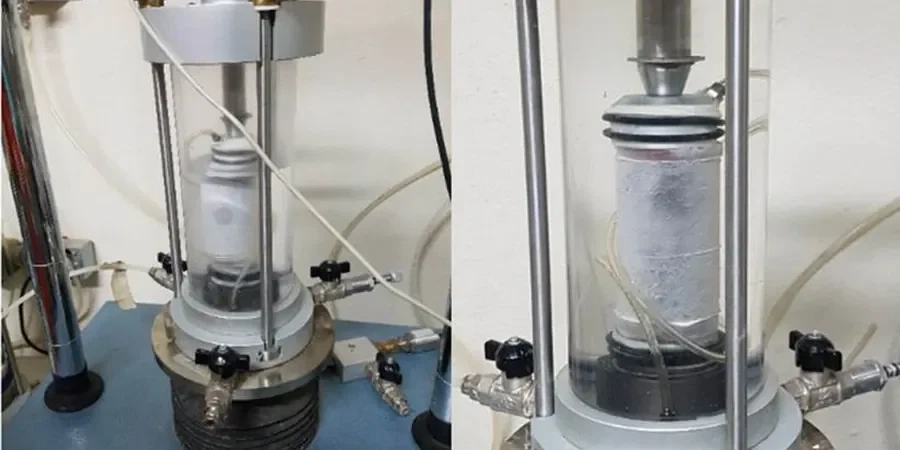
Advanced oedometer testing for swelling pressure and free swell, combined with active zone depth assessment. We deliver a heave magnitude estimate and specific foundation type recommendations (post-tensioned slab, drilled piers, or soil replacement).
What are the first signs of expansive soil problems in a Riverside home?
Look for diagonal cracks in drywall above doors and windows, uneven floor slabs, and sticking doors or windows. During dry months you may see wide surface cracks in the yard, while after rain those cracks close as the soil swells. These symptoms typically appear 2 to 5 years after construction if the foundation was not designed for the site's expansion index.
How much does an expansive soil evaluation cost in Riverside?
A standard residential evaluation with Atterberg limits, expansion index, and basic oedometer testing ranges from US$630 to US$1,780, depending on the number of samples and the depth of the active zone investigation. Larger commercial projects with multiple boreholes and advanced suction testing fall at the upper end of that range. Contact us for a site-specific quote.
Can expansive soil be treated without replacing the foundation?
Yes, in many cases. Options include soil moisture control (perimeter drains, proper grading, irrigation management), chemical stabilization with lime or cement injection, and post-tensioned slab retrofitting. However, these measures work best when the expansive soil evaluation in Riverside identifies the actual swelling pressure and active zone depth early. For already-damaged foundations, underpinning with helical piers is a common solution.