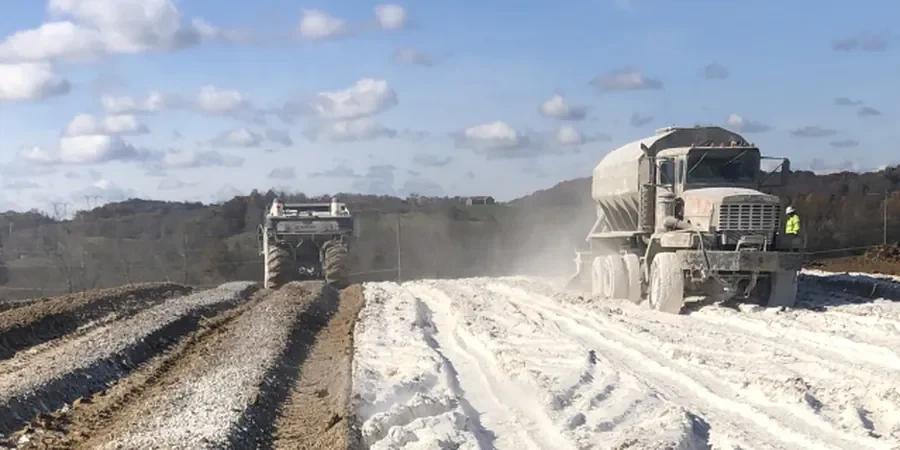
The Santa Ana River basin and the alluvial fans around Riverside create a tricky mix for road construction. You get everything from highly expansive clays near the river terraces to loose, collapsible sands on the old floodplains. That contrast means a standard subgrade prep often fails within two rainy seasons. We tackle that variability head-on with targeted soil stabilization for roads. Before we recommend any additive or mechanical method, we run a full characterization. That includes Atterberg limits to gauge plasticity and a Proctor compaction curve to find the optimum moisture window. For sections where the clay plasticity index exceeds 25, we typically combine lime treatment with a short curing period. But we don't guess; we test first. Our lab data drives every decision for the road section.
Stabilizing the subgrade with the right binder based on lab data prevents reflective cracking and extends pavement life by 8 to 12 years in Riverside’s climate.
Method and coverage
Take a typical widening project on a collector road near the 91 freeway. The existing subgrade might show a CBR value below 3 after saturation, which is useless for pavement support. In Riverside, the seasonal moisture swings from dry summers to wet El Niño winters cause cyclic swell-shrink in the clay layers. That movement cracks the pavement surface within months. Our approach starts with a grid of test pits and density tests to map the problematic zones. Then we evaluate alternatives: cement stabilization for sands with low plasticity, or lime for high-PI clays. Before finalizing the mix design, we correlate the lab results with field conditions using a CBR Vial test to confirm the soaked strength meets the 15% minimum for subbase. For deep soft layers, precarga y sobrecarga with wick drains accelerates consolidation before paving. Each solution is matched to the specific soil horizon.
Technical reference image — Riverside
Regional considerations
Riverside grew fast after the postwar boom, and many older roads were built directly on untreated native soil. The alluvial terraces contain discontinuous clay lenses that swell when wet and shrink during the dry season. That differential movement creates longitudinal cracking along the wheel paths, and in some cases causes shoulder drop-offs of 3 to 4 inches. The risk is higher on roads built before the 1990s, when soil stabilization for roads was rarely specified. Today, the City of Riverside requires a geotechnical report for any street improvement project. We routinely see projects where a cheap initial fill was used, and now the pavement has failed within 5 years. Proper treatment at the start avoids those reconstruction costs.
Full mix design including moisture-density relationship, unconfined compressive strength tests at 7 and 28 days, and swell potential after treatment. We deliver a binder rate and curing protocol specific to your borrow source or in-situ soil.
02
Mechanical Stabilization & Subgrade Reinforcement
Evaluation of deep dynamic compaction or replacement of soft pockets. We also specify geotextile separation layers and aggregate interlayers when the subgrade CBR is below 3. Field density verification using sand cone or nuclear gauge is included.
How does Riverside's climate affect soil stabilization for roads?
The semi-arid climate with intense winter rains causes cyclic wetting and drying. Expansive clays in the river terraces swell during wet months and shrink in summer, which destabilizes untreated subgrades. Stabilization with lime or cement reduces volume change and keeps the road structure stable year-round.
What soil types in Riverside require stabilization the most?
The high-plasticity clays (CH) found near the Santa Ana River and the loose silty sands (SM) on the alluvial fans are the most problematic. Both have CBR values below 5 when saturated and need chemical or mechanical treatment before pavement placement.
How deep does soil stabilization typically go for a road project?
For most residential and collector roads, treatment depth ranges from 12 to 18 inches below the subgrade surface. For arterial roads with heavy truck traffic, we sometimes go to 24 inches using cement-treated base or lime-modified subgrade.
What is the cost range for soil stabilization in Riverside?
For a typical project, the cost for design, testing, and field verification ranges between US$750 and US$2,780. That covers lab mix design, field density tests, and a final report. The exact figure depends on the volume of soil treated and the number of test locations.
Do you test the stabilized soil after construction?
Yes. We perform field density tests (sand cone or nuclear gauge) and take undisturbed samples for unconfined compression testing. We also check the in-situ CBR with a portable tester to confirm the design strength is achieved before the base course is placed.