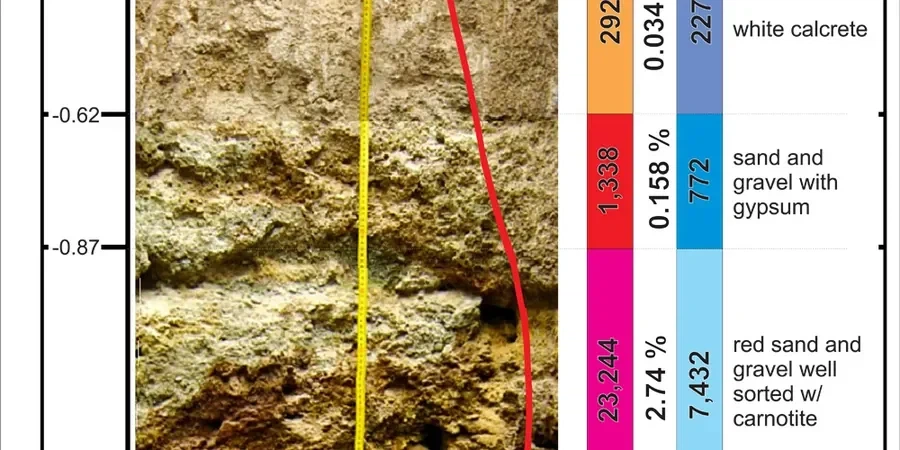
Riverside sits on deep alluvial deposits from the Santa Ana River, with sandy and silty layers reaching down over 100 feet in many areas. The water table fluctuates seasonally, often sitting between 15 and 30 feet deep near the river corridor, while higher terraces show drier conditions with collapsible soils. An exploratory test pit in Riverside allows our team to log soil profiles in real time, photograph the stratigraphy, and take bulk or block samples directly from the excavation face. For shallow foundation projects on these alluvial terraces, the visual confirmation of layer boundaries and the presence of loose sand lenses is essential before moving to a more detailed ensayo SPT program for quantitative resistance data.
In Riverside's alluvial terraces, a single test pit can reveal loose sand lenses or undocumented fill that would be invisible to SPT alone.
Method and coverage
Riverside grew rapidly through the citrus boom of the early 1900s, and many older neighborhoods have undocumented fill or undocumented grading beneath existing slabs. An exploratory test pit cuts through this uncertainty by giving us a direct window into the ground. Our crew excavates a pit typically 3 to 5 feet wide and up to 12 feet deep, depending on safety constraints and shoring requirements. We log every change in soil type, note moisture variations, and classify the material using ASTM D2488 visual-manual procedures. In areas where loose sands or soft clays show up, we coordinate with a clasificación de suelos lab program to confirm index properties and guide the foundation design.
Technical reference image — Riverside
Regional considerations
A common mistake we see in Riverside is contractors relying solely on SPT borings for shallow residential slabs, missing loose sand pockets or undocumented fill between boreholes. An exploratory test pit in Riverside exposes these hidden lenses directly, allowing the design team to adjust footing depths or recommend over-excavation before concrete is poured. Missing this step leads to differential settlement, cracked slabs, and costly callbacks within the first few years. The visual evidence from a properly logged test pit prevents that entire chain of failure.
When undisturbed samples are required for consolidation or triaxial testing, we carve and wax-seal block samples directly from the pit wall. This preserves the in-situ density and moisture content for later lab work.
02
Field Density Verification via Sand Cone
For each soil layer encountered, we run field density tests using the sand cone method per ASTM D1556. This gives immediate data on compaction state and helps identify loose zones needing remediation.
03
Collapse Potential Field Screening
In Riverside's drier terrace deposits, we perform a simple field collapse screening by wetting the pit wall and observing settlement behavior. This quick check flags metastable soils before they become a slab problem.
Standards that apply
ASTM D2488: Standard Practice for Description and Identification of Soils, ASTM D420: Standard Guide for Site Characterization for Engineering Purposes, IBC 2021 Chapter 18: Soils and Foundations, ASCE 7-16: Minimum Design Loads and Associated Criteria
Q&A
How deep can you excavate a test pit in Riverside?
We typically reach 12 feet in stable soils without shoring. For deeper exploration, we install trench boxes or hydraulic shoring to meet OSHA requirements. Depths beyond 15 feet usually require transitioning to a bored sampling method.
What does an exploratory test pit cost in Riverside?
The typical range for a test pit in Riverside is between US$530 and US$740, depending on depth, shoring needs, and number of samples. Volume discounts apply for multi-pit projects across a single subdivision.
When should I choose a test pit over SPT borings?
Choose a test pit when you need to see the soil profile directly, photograph the stratigraphy, or extract undisturbed block samples for lab testing. Test pits are ideal for shallow foundations, utility trenches, and undocumented fill evaluation, while SPT borings are better for deeper profiles and quantitative resistance data.