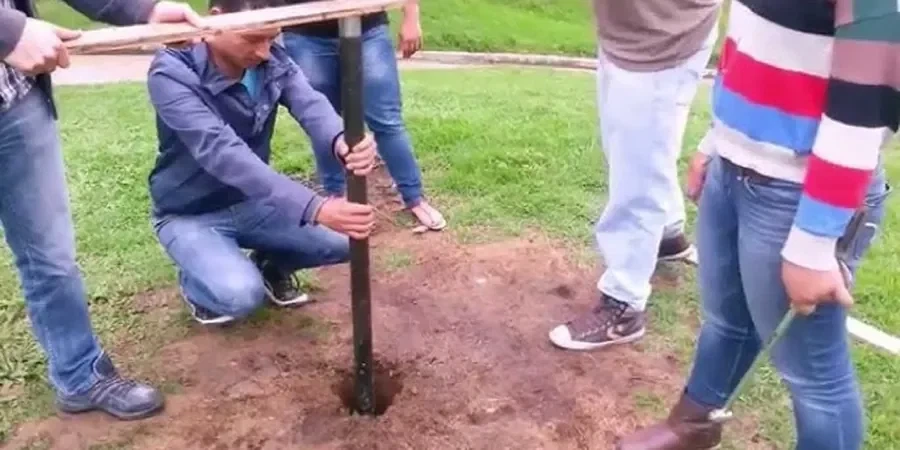
We were called to a site near the Santa Ana River where a four-story apartment building was planned. The soil log showed soft clay extending more than 12 meters deep. Standard penetration tests gave almost no resistance in the upper layers. That is when the field vane shear test (VST) becomes essential. It measures undrained shear strength directly in place, without disturbing the sensitive structure of these clays. In Riverside, where alluvial deposits from the river and older lakebed sediments create thick soft zones, the VST is often the only reliable way to get design parameters for shallow foundations or embankments. We combine it with MASW testing to correlate shear wave velocity with vane results, and with CPT soundings when continuous profiling is needed. The vane gives us a peak and a remolded value, so we can also assess sensitivity.
In Riverside, where alluvial clays can be soft and sensitive, the VST provides undrained shear strength directly in place — no sampling disturbance, no delay.
Method and coverage
Silty clays near downtown Riverside behave differently than the stiff alluvial fans along the 91 freeway corridor. In the central basin, we routinely find soft to medium stiff clays with undrained strengths between 15 and 40 kPa. The VST is ideal here because it tests the soil at rest, without the drainage that can occur during sampling. We follow ASTM D2573, using a 65 mm diameter vane with a height-to-diameter ratio of 2. The vane is pushed slowly into undisturbed soil, then rotated at 6 degrees per minute. The torque at failure gives us su directly. For highly sensitive clays, we also measure the remolded strength after several rotations. This data feeds directly into stability analysis for slopes and bearing capacity checks. In Riverside, where irrigation and seasonal rainfall can soften the ground, knowing the in-situ strength is critical before designing retaining walls or shallow footings. The equipment is light and portable, so we can test in tight spaces between existing structures.
Technical reference image — Riverside
Regional considerations
ASCE 7 and the California Building Code require site-specific characterization for Seismic Design Categories D, E, and F. In Riverside, many sites fall into Category D or E due to the presence of soft soils and proximity to active faults. The VST directly measures undrained strength, which is needed for evaluating liquefaction triggering in clay-like soils using the Youd-Idriss method. But the main risk is underestimating sensitivity: if the clay is highly sensitive and you use peak strength for a permanent foundation, you may get large deformations under cyclic loading. We always correlate VST results with laboratory index tests to confirm plasticity and avoid misclassifying silts as clays. A 2018 failure in a Riverside retention basin was traced back to using peak vane strength without accounting for strain softening. That is why we test carefully and report both peak and remolded values.
From ground surface to 30 m (limited by rod buckling)
Complementary services
01
Standard VST – Shallow and Intermediate Depths (0–15 m)
For sites with soft clay layers within the upper 15 meters. Includes vane insertion, peak and remolded readings at 1.5 m intervals, and a report with su profiles and sensitivity values. Suitable for residential and light commercial projects.
02
Advanced VST with CPT Correlation (0–30 m)
Combined VST and CPT testing to correlate undrained shear strength with cone tip resistance. Provides continuous strength profiles and allows identification of thin sensitive layers. Recommended for deep foundations, embankments, and seismic evaluations in Riverside's alluvial basin.
Standards that apply
ASTM D2573-24 – Standard Test Method for Field Vane Shear Test in Saturated Fine-Grained Soils, ASTM D2487 – Standard Practice for Classification of Soils for Engineering Purposes (Unified Soil Classification System), ASCE 7-22 – Minimum Design Loads and Associated Criteria for Buildings and Other Structures (Section 11.8 – Site Characterization)
Q&A
When should I request a field vane shear test instead of a triaxial test?
Use the VST when the soil is soft, saturated, and likely to be disturbed by sampling. In Riverside's alluvial clays, the VST measures undrained strength in situ without the sample disturbance that can reduce measured strength in the lab. It is faster and cheaper than a triaxial test for soft clays, but it only measures undrained conditions.
How much does a field vane shear test cost in Riverside?
For a typical Riverside project with 6 to 10 test points, the cost ranges from US$560 to US$1,630. The final price depends on depth, number of readings, and site access. We include a full report with peak and remolded strengths.
What soil types are suitable for the vane shear test?
The VST works best in fine-grained soils: clays, silty clays, and clayey silts with undrained strengths below about 200 kPa. It is not recommended for sands, gravels, or stiff overconsolidated clays where the vane may shear along the blades instead of the soil. In Riverside, it is particularly useful for the soft lacustrine and alluvial clays found near the Santa Ana River and in the central basin.
Can the VST be performed in confined spaces or inside excavations?
Yes. The equipment is compact and can be manually carried into basements, trenches, or between existing foundations. We have performed VSTs inside shored excavations for Riverside retaining wall projects where access was limited. The vane is lowered through a drill rod string or pushed from a lightweight tripod.