Hillside lots near the Box Springs Mountains demand different slope stabilization design than flat parcels along the Santa Ana River. The alluvial fan deposits under downtown Riverside are dense sands and gravels with occasional clay lenses, while the steeper terrain west of the 215 Freeway exposes weathered granitic bedrock prone to planar sliding. A slope stabilization design for a cut on a 2:1 face in the La Sierra area requires deeper failure surface analysis compared to a fill slope on the river terrace near Fairmount Park. Before starting field work, we typically run a MASW survey to map velocity contrasts and identify potential slip zones without drilling every bench.
In Riverside's alluvial fans, the critical failure surface often follows a clayey silt seam less than 5 cm thick.
Method and coverage
We use a track-mounted drill rig with hollow-stem augers for soil sampling and a portable cone penetrometer for shallow strength profiles. On steep slopes in Riverside, the rig is winched into position; on flat sites it operates on its own pads. The equipment collects undisturbed tube samples and SPT blow counts every 1.5 meters. When the soils are too dense for the CPT, we switch to rotary coring with a triple-tube barrel to preserve fabric. Field data feeds directly into limit-equilibrium models (Bishop simplified, Spencer) and finite-element codes. For retaining structures at the toe, we coordinate with the anchor design team to match load capacity with soil stratigraphy. All shear strength parameters are verified by direct shear or triaxial tests in our accredited lab.
Technical reference image — Riverside
Regional considerations
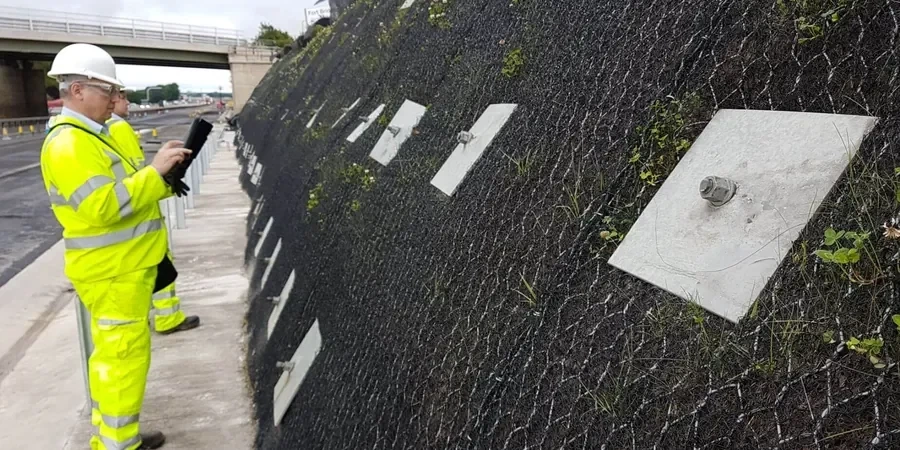
Rapid suburban expansion into the foothills east of Riverside since the 1980s has created thousands of homes on cut-and-fill lots. Many of these developments were built before modern subsurface investigation requirements. The result: seasonal rainfall infiltrates through undocumented fill, raises pore pressure along the original ground surface, and triggers shallow translational slides. A slope stabilization design for a 1980s-era home in the Canyon Crest area typically finds loose fill over a slickensided paleosol — a classic setup for winter failures. We recommend targeted drainage and soil nailing rather than regrading the entire slope.
Two-dimensional models using Bishop and Spencer methods. We calibrate strength parameters against SPT blow counts and lab triaxial results specific to Riverside's alluvium and weathered granite.
02
Finite-Element Deformation Analysis
For complex slope geometries or when adjacent structures are sensitive to movement. We model staged construction and seismic loading per ASCE 7 site class D or E.
03
Drainage & Reinforcement Design
Includes horizontal drains, French drains, soil nails, and anchored walls. All designs reference FHWA guidelines and account for Riverside's seasonal precipitation patterns.
What is the typical cost for a slope stabilization design in Riverside?
For a single-family lot with one or two cross sections, the design fee ranges between US$1,900 and US$6,090 depending on the number of borings, lab tests, and analysis methods required.
Do I need a slope stabilization design for a retaining wall under 4 feet?
Yes, if the retained soil supports a structure or the wall is on a slope steeper than 3:1. Riverside building officials often require a geotechnical report with stability calculations for walls exceeding 3 feet in height.
How deep do borings need to be for slope analysis in Riverside?
Borings should extend at least 1.5 times the slope height below the toe, or until encountering competent bedrock. In Riverside's alluvial fans, this often means 15 to 25 feet. The depth must capture the potential failure surface.
What factor of safety does Riverside require for slopes?
The city adopts IBC 2021 standards: minimum 1.5 for static conditions and 1.1 for pseudo-static seismic loads. Higher factors may be required for slopes adjacent to critical infrastructure or in liquefaction-prone areas.