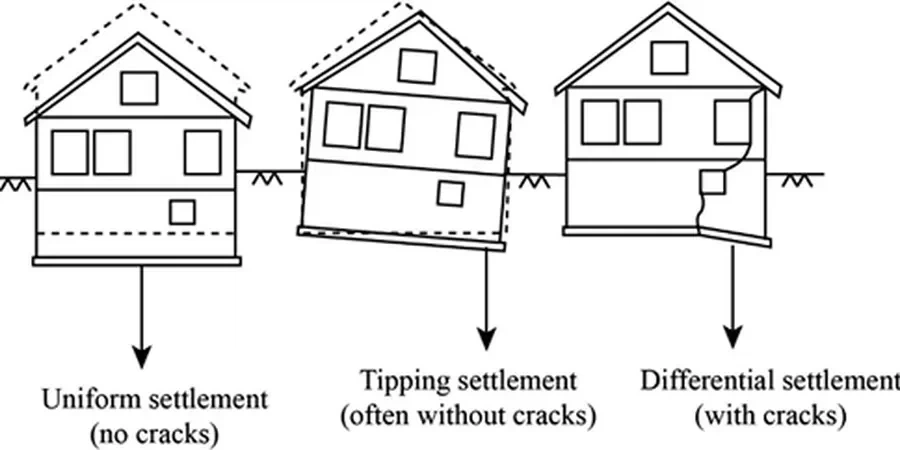
Riverside sits on a complex alluvial fan system fed by the Santa Ana River. The subsurface here is anything but uniform: layers of sand, gravel, silt, and clay shift abruptly within meters. That variability is exactly why differential settlement analysis is critical for any new foundation or retrofit project in the city. Without a detailed evaluation of soil compressibility and layer thickness changes, a slab can crack and a wall can tilt before the building is even finished. We combine borings with SPT data and lab consolidation tests to map these transitions, then run settlement calculations per IBC 2021. The goal is to predict how much each footing will settle and, more importantly, whether the difference between them stays within structural limits. For sites near the river or on old agricultural fill, this analysis is non-negotiable.
The difference between 10 mm and 50 mm of differential settlement often comes down to a two-foot-thick clay lens nobody expected.
Method and coverage
Over 330,000 people live in Riverside, many on parcels that were once citrus groves or floodplains. Those legacy soils often hide buried organic layers and loose sands that compress unevenly under load. In our experience, a standard soil report is not enough here. We run a full suite of consolidation tests, including oedometer curves at multiple load increments, to capture pre-consolidation stress and compression index. Those parameters feed directly into the settlement model. To refine the soil profile further, we often pair this work with MASW testing for shear-wave velocity layering and CPT soundings when we need continuous stratigraphy without sample disturbance. On deeper fills, borehole logging helps identify loose zones that would cause excessive settlement under footings.
Technical reference image — Riverside
Regional considerations
Take a home near Canyon Crest versus one on the Arlington Heights bench. The first sits on young alluvium with interbedded soft clays; the second rests on older, denser fan deposits. Ignoring those differences can produce a 40 mm differential settlement across a 12-meter slab, enough to fracture drywall and jam doors. The real risk in Riverside is the abrupt lateral change: a sand channel from an old river course can be just a few meters wide, and a footing on clay next to it will settle twice as much. That is why we always run multiple borings per site, not one, and cross-check with a dilatometer test when we suspect stiff layers above soft ones.
Continuous sampling with SPT and thin-wall tubes to capture undisturbed clay samples for consolidation testing.
02
Consolidation Testing (Oedometer)
One-dimensional consolidation tests per ASTM D2435 to determine Cc, Cr, and σ'p for settlement predictions.
03
Settlement Modeling & Reporting
Elastic and consolidation settlement calculations using site-specific soil parameters, with recommendations for allowable bearing pressure.
04
Mitigation Recommendations
Design of deep foundations, surcharge preloading, or Improvement (e.g., deep soil mixing) when differential settlement exceeds allowable limits.
Standards that apply
IBC 2021 – Chapter 18: Soils and Foundations, ASTM D2435: Standard Test Method for One-Dimensional Consolidation Properties of Soils, ASCE 7-22: Minimum Design Loads and Associated Criteria for Buildings, ASTM D1586-18: Standard Test Method for Standard Penetration Test (SPT)
Q&A
What is differential settlement and why does it matter in Riverside?
Differential settlement is the uneven vertical movement between two or more foundation elements. In Riverside, the alluvial soils change rapidly across a site, so one footing can settle 25 mm while an adjacent one settles only 5 mm. That difference can crack slabs, tilt walls, and damage structural frames. We analyze it to keep differential movement under the IBC limit of 19 mm for most buildings.
How much does a differential settlement analysis cost in Riverside?
For a typical single-family home lot, the cost ranges between US$630 and US$2,030 depending on the number of borings, lab tests, and modeling complexity. That includes field sampling, consolidation tests, and a detailed report with settlement predictions. Larger commercial projects with multiple footings may fall at the higher end.
What consolidation test parameters do you measure?
We measure the compression index (Cc), recompression index (Cr), pre-consolidation stress (σ'p), and coefficient of consolidation (Cv). These parameters go into the settlement equation to predict how much and how fast each layer will settle under the applied load.
Can you recommend a foundation type to avoid differential settlement?
Yes. If the analysis shows more than 19 mm of differential movement, we often recommend deep foundations (piles or drilled shafts) bearing on the dense sands below 10 meters, or a stiffened mat foundation designed to bridge soft spots. Surcharge preloading with wick drains is another option for larger sites with thick clay layers.