In Riverside, we often see that the alluvial deposits along the Santa Ana River and the older terraces on the city's east side present very different consolidation behaviors. A preloading with surcharge design must account for that variability. The soft clays and silts near the river can take months to reach primary consolidation, while the denser sands on the benchlands settle much faster. We always start with a detailed site investigation. That includes boreholes and sampling to measure initial void ratio and preconsolidation pressure. Before we finalize any surcharge height or duration, we complement the data with an asentamiento diferencialanalysis to predict differential movements across the site. Then we run consolidation tests to determine Cc and Cr values specific to each stratum.
In Riverside's alluvial soils, a staged surcharge with real-time piezometer monitoring is the only reliable way to guarantee post-construction settlement within tolerance for warehouse slabs and road embankments.
Method and coverage
A common mistake we see from contractors in Riverside is assuming that a uniform surcharge fill will produce uniform settlement across the entire pad. That rarely happens. The subsurface here changes rapidly, especially where old channels from the Santa Ana River cut through. A proper preloading with surcharge design should include staged loading with settlement monitoring. We install settlement plates and piezometers to track pore pressure dissipation in real time. If the rate of consolidation is too slow, we can accelerate it with vertical drains. For sites where the bearing capacity of the native soil is very low, we also evaluate a compactacion dinamica alternative as a pre-treatment before placing the surcharge. The key parameters we control are:
Final surcharge height (typically 1.5 to 3 times the design load)
Loading rate to avoid shear failure
Duration based on 90% to 95% primary consolidation
Under-fill and over-fill compensation for post-construction settlement
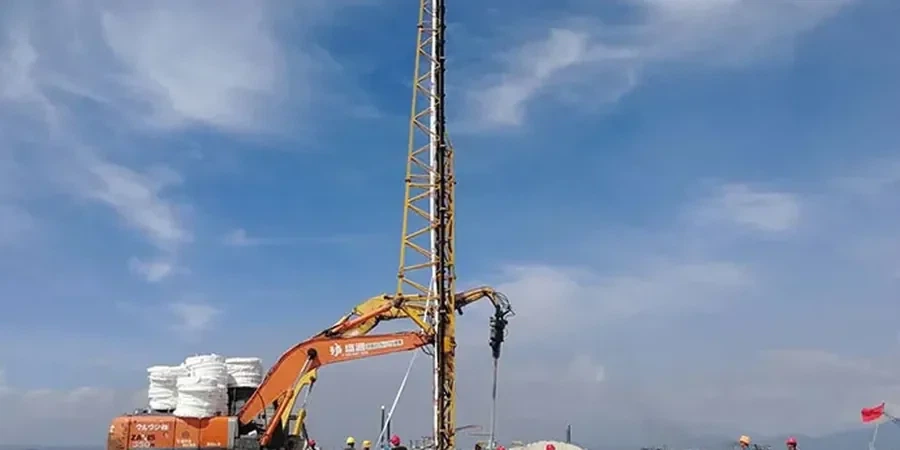
Technical reference image — Riverside
Regional considerations
The shallow groundwater table in Riverside's floodplain sits at 2 to 4 meters depth during wet seasons. That directly affects the preloading with surcharge design because high pore pressures reduce effective stress gain during loading. If we apply surcharge too fast, the foundation soil can undergo undrained shear failure. We have seen cases where a 3-meter surcharge lift caused a mud wave and edge heave in a storage yard near the 91 freeway. The risk is real. That is why we always model the staged loading with consolidation analysis using actual Cv values from the site, not assumed regional averages. For deeper deposits we also run drenes-verticales analysis to see if wick drains can shorten the consolidation time safely.
Complete design including fill height, loading schedule, and settlement plate layout. We specify piezometer locations and frequency of readings. The design targets 90% primary consolidation within the construction window, with a factor of safety of 1.5 against bearing failure.
02
Vertical Drain + Surcharge Optimization
For Riverside sites with thick clay layers (over 5 m), we combine preloading with surcharge and prefabricated vertical drains (PVDs). We calculate drain spacing, pattern (triangular or square), and equivalent radial consolidation time. This reduces wait time from months to weeks.
Standards that apply
ASCE 7-22 (Minimum Design Loads and Associated Criteria), ASTM D2435 (Standard Test Methods for One-Dimensional Consolidation of Soils), ASTM D1586-18 (Standard Test Method for Standard Penetration Test), IBC 2021 Chapter 18 (Soils and Foundations), FHWA NHI-05-037 (Design and Construction of Embankments on Soft Ground)
Q&A
What is the typical duration for preloading with surcharge in Riverside's alluvial soils?
For a 3-meter surcharge on 6 meters of soft clay near the Santa Ana River, we typically design for 4 to 8 months to reach 90% consolidation. In the older terrace deposits east of the 215 freeway, the same surcharge may achieve 90% in 2 to 3 months because the soils are denser. The duration depends heavily on the coefficient of consolidation (Cv) of each layer.
How much does a preloading with surcharge design study cost in Riverside?
For a typical 2-acre site with 4 boreholes and consolidation testing, the design study including report and instrumentation plan ranges between US$780 and US$2,490. The final cost depends on the number of soil strata, depth of soft layers, and whether vertical drains are included in the analysis.
What happens if the surcharge is removed too early?
If the surcharge is removed before reaching the target degree of consolidation, the foundation will track record additional settlement after construction. That can cause slab cracking, differential movement at column lines, and pavement distress. We always set a minimum of 90% primary consolidation as the trigger for removal, verified by settlement plate readings and pore pressure dissipation data.
Do you need a special permit from the city of Riverside for a surcharge fill?
Yes, surcharge fills over 4 feet in height typically require a grading permit from the City of Riverside Public Works Department. The permit application needs a geotechnical report that includes the preloading with surcharge design, stability analysis, and a monitoring plan. We prepare all the technical documentation to support the permit submittal.