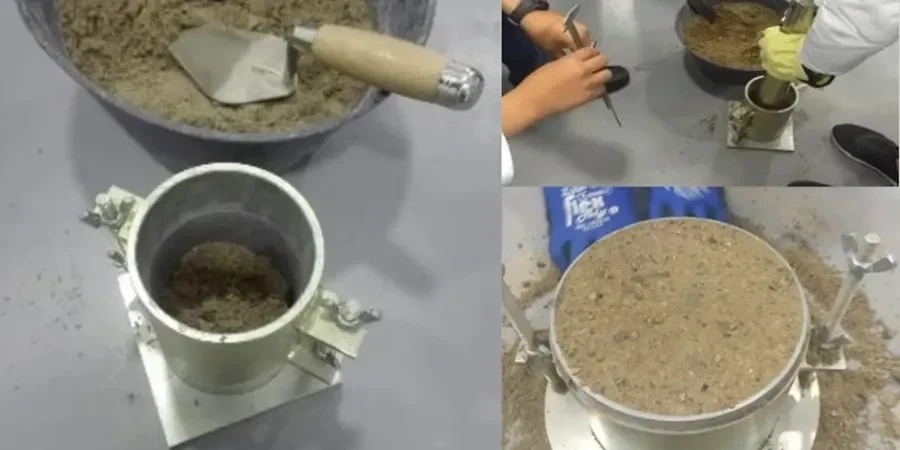
Riverside’s growth from citrus groves into a sprawling Inland Empire hub has placed enormous demand on engineered fills and compacted subgrades. The alluvial terraces along the Santa Ana River, combined with the old alluvial fans from the Box Springs Mountains, produce soils that vary from silty sands to fat clays within a single subdivision. Without a reliable compaction reference, fill placement becomes guesswork. The Proctor test — both Standard (ASTM D698) and Modified (ASTM D1557) — establishes the target dry density and optimum moisture content for each soil type encountered. Our lab in Riverside runs these curves alongside granulometría to ensure the material gradation supports the compaction effort specified by the geotechnical engineer.
For most Riverside structural fills, the Modified Proctor (ASTM D1557) produces a target density 5 to 8 pcf higher than Standard — a critical difference for pavement subgrade performance.
Method and coverage
At an elevation of 827 feet, Riverside sits in a zone where annual precipitation averages barely 10 inches, yet the occasional El Niño winter can saturate fills rapidly. The Modified Proctor method (ASTM D1557) is almost always specified for structural fills supporting pavements or shallow foundations in this region, because the heavier rammer (10 lb, 18-inch drop) better simulates modern vibratory rollers. For lighter fills — such as landscape berms or utility trench backfill — the Standard Proctor (ASTM D698) with a 5.5 lb rammer suffices. The lab determines the maximum dry density and optimum moisture content from five points, then plots the compaction curve. When the soil contains significant oversize particles (>30% retained on No. 4 sieve), we apply the correction method per ASTM D4718. The entire process takes three to five business days for a single sample.
Technical reference image — Riverside
Regional considerations
A common mistake in Riverside is assuming the same Proctor curve works for both the native alluvial sand and the imported clayey fill brought from a nearby borrow site. Each material has a distinct optimum moisture content. If the contractor compacts the clayey fill at the moisture level that worked for the sand, the clay may be 3–5 points dry of optimum, leading to low density and a honeycombed structure that settles under load. The compaction curve is soil‑specific; reusing old data is a fast track to differential settlement. We always run a fresh Proctor test on every distinct soil type that will be placed as fill.
No. 4 sieve (4.75 mm) in 4-inch mold; 3/4-inch in 6-inch mold
Oversize correction
ASTM D4718 method for material retained on No. 4 sieve
Turnaround time
3–5 business days per sample; rush available
Complementary services
01
Standard Proctor (ASTM D698)
For non‑structural fills, landscape grading, and utility trench backfill where compaction effort is lower. Test uses a 4‑inch mold and 5.5 lb hammer; results include the full moisture‑density curve and report suitable for Caltrans submittals.
02
Modified Proctor (ASTM D1557)
Specified for all structural fills in Riverside — pavement subgrades, building pads, retaining wall backfill, and MSE wall zones. Higher compaction effort yields a curve that correlates directly with field roller performance. Includes oversize correction per ASTM D4718 when needed.
Standards that apply
ASTM D698 – Standard Proctor (12,375 ft-lbf/ft³), ASTM D1557 – Modified Proctor (56,250 ft-lbf/ft³), ASTM D4718 – Correction for oversize particles, ASTM D2216 – Laboratory determination of water (moisture) content, Caltrans Standard Specifications Section 19 (compaction criteria)
Q&A
How is the Proctor test different from a field density test (sand cone or nuclear gauge)?
The Proctor test is a laboratory method that establishes the target maximum dry density and optimum moisture content for a specific soil. The field density test (sand cone or nuclear gauge) measures the in‑place dry density and moisture after compaction. You compare the field result against the Proctor target to calculate percent compaction — typically specified at 90% to 95% of Modified Proctor for structural fills in Riverside.
When should I specify Modified Proctor instead of Standard Proctor?
Modified Proctor (ASTM D1557) is required by most Riverside building codes and Caltrans specifications for structural fills supporting pavements, foundations, MSE walls, and retaining walls. The heavier compaction effort better simulates modern vibratory rollers. Standard Proctor (ASTM D698) is appropriate for light fills such as landscape berms, planter areas, and shallow utility trenches where compaction energy is lower.
How long does a Proctor test take, and how much soil sample is needed?
A single Proctor test typically requires 3 to 5 business days from sample receipt. We need approximately 35 to 50 pounds of representative material, placed in a sealed bag to preserve natural moisture. For samples containing oversize particles (>30% retained on No. 4 sieve), we request a larger volume to perform the oversize correction per ASTM D4718.
What is the typical cost range for a Proctor test in Riverside?
The cost for a Standard or Modified Proctor test generally falls between US$90 and US$210 per sample, depending on the number of compaction points (typically five), the mold size (4‑inch vs. 6‑inch), and whether oversize correction is needed. Volume discounts apply for multiple samples from the same project.
Do you coordinate Proctor testing with field density verification?
Yes. Many Riverside projects require both the laboratory Proctor curve and field density tests (sand cone or nuclear gauge) to confirm that the contractor achieves the specified percent compaction. We can schedule the Proctor test first, then the field technician performs density tests during fill placement. Results are cross‑referenced against the same Proctor curve for consistency.