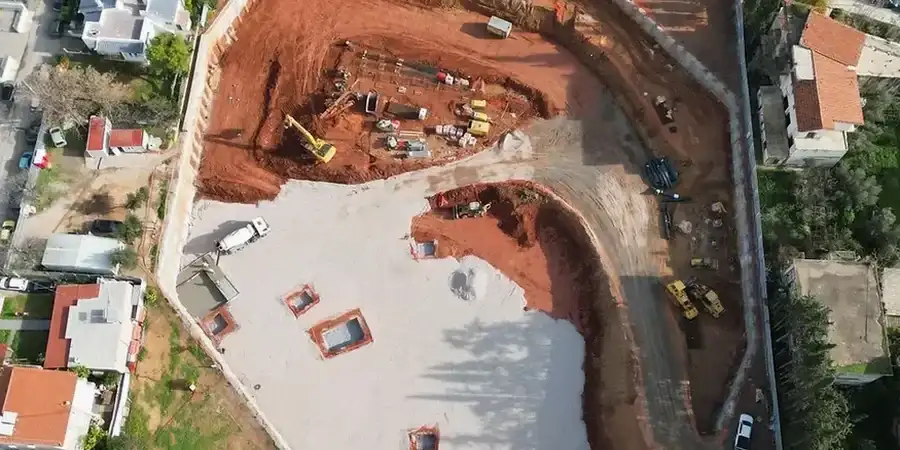
Many contractors in Riverside underestimate the variability of the alluvial fan deposits that underlie the city. A typical mistake is assuming uniform soil conditions across the site, which leads to under-designed shoring for deep excavations. The Santa Ana River floodplain has left behind a complex mix of sands, silts, and gravels that change within meters. Without proper geotechnical design of deep excavations, the risk of a cave-in or excessive wall deflection is real. We have seen projects stall because the temporary support system was not matched to the actual soil profile. That is why we insist on a thorough subsurface investigation before any deep excavation work begins. Combining standard penetration tests with MASW-VS30 surveys gives us the shear wave velocity data needed to model lateral earth pressures accurately.
A deep excavation design that ignores Riverside's alluvial variability is a structural gamble. We base every recommendation on site-specific data.
Method and coverage
Downtown Riverside sits on older, denser alluvium, while areas near the Santa Ana River have looser, water-bearing sands. These differences directly impact shoring design. For a deep excavation in the river-adjacent zones, groundwater control becomes a priority. In the downtown area, the challenge is often stiff clays that can swell or shrink. Our geotechnical design of deep excavations addresses both extremes. We evaluate the soil stratigraphy, groundwater levels, and seismic site class per ASCE 7. The outcome is a shoring system that fits the actual ground conditions, not a generic solution. We also integrate monitoring of slope stability when the excavation is adjacent to existing structures or roadways.
Technical reference image — Riverside
Regional considerations
Riverside lies in a seismically active region with a PGA of up to 0.6g. The alluvial soils can amplify ground motions, especially where loose sands are present. For a deep excavation, this means the temporary shoring must resist not only static earth pressures but also dynamic loads from an earthquake. Liquefaction potential is a concern in saturated granular layers near the river. Our geotechnical design of deep excavations accounts for these seismic risks. We model the soil-structure interaction under both static and seismic conditions. The result is a support system that keeps the excavation stable during construction and protects adjacent buildings from damage.
Design of soldier pile and lagging walls, sheet pile walls, or secant pile walls. We calculate lateral earth pressures, bending moments, and tieback loads. All designs comply with IBC and ASCE 7 seismic requirements.
02
Groundwater Control Strategy
Evaluation of dewatering needs, well point systems, and cutoff walls. We model groundwater flow in the alluvial aquifer using site-specific permeability data. The goal is to keep the excavation dry without causing settlement in adjacent areas.
Standards that apply
ASCE 7-22 Minimum Design Loads and Associated Criteria for Buildings, IBC 2021 International Building Code Chapter 18, ASTM D1586-18 Standard Test Method for SPT, FHWA-NHI-05-3 Geotechnical Circular No. 2: Earth Retaining Systems
Q&A
What is the typical cost range for geotechnical design of deep excavations in Riverside?
The cost for a complete geotechnical design package for deep excavations in Riverside typically falls between US$2,330 and US$8,090. The final price depends on the excavation depth, number of borings, and complexity of the shoring system. We deliver a detailed quote after reviewing the project scope.
How do you determine the lateral earth pressure for a deep excavation in Riverside?
We determine lateral earth pressures using the Rankine or Coulomb theories, adjusted for the actual soil parameters measured in our laboratory. For cohesive soils we use undrained shear strength from triaxial tests. For granular soils we use friction angles from direct shear tests. Seismic pressures are added using the Mononobe-Okabe method per ASCE 7.
What is the minimum depth that requires a deep excavation design?
In Riverside, any excavation deeper than 1.5 m requires a shoring design per Cal-OSHA regulations. For depths exceeding 6 m, we recommend a full geotechnical design of deep excavations including numerical modeling. Projects near the river or in loose sands may need a design even at shallower depths due to groundwater and seismic risks.