The 2019 California Building Code (CBC), based on ASCE 7-16, requires slope stability analysis for any cut or fill steeper than 1.5:1 in Riverside. This is not optional. Riverside sits on a mix of alluvial fans, older terrace deposits, and weathered granite from the Box Springs Mountains. Heavy winter rains — the city averages 11 inches per year — can trigger shallow slides in these materials. We apply Bishop’s simplified method and Spencer’s procedure, using drained shear strengths from direct shear tests and residual friction angles. Every analysis includes seepage modeling for perched water tables common in Riverside’s foothill subdivisions. Our lab holds ISO 17025 accreditation for geotechnical testing, so the numbers you get are defensible in plan check or litigation.
Silty sands from the Santa Ana River floodplain lose up to 40% of strength when saturated — we model worst-case winter conditions every time.
Method and coverage
Silty sands from the Santa Ana River floodplain behave very differently than the clayey gravels found near Lake Matthews. In Riverside, we see Factor of Safety values that shift by more than 0.3 between dry summer conditions and saturated winter conditions. That is why we run both short-term undrained and long-term drained analyses. For slopes adjacent to Woodcrest or the hills above Canyon Crest, we often combine our stability models with vane shear testing to get undisturbed peak strengths in soft zones. Our standard deliverables include:
Critical slip surface geometry (circular and non-circular)
Pore pressure isobars from steady-state seepage
Parametric sensitivity on cohesion and friction angle
We cross-check every result with limit equilibrium (LEM) and, when the budget allows, finite element (FEM) using Plaxis 2D. The goal is a defensible FoS that meets both IBC minimums and Riverside County grading ordinances.
Technical reference image — Riverside
Regional considerations
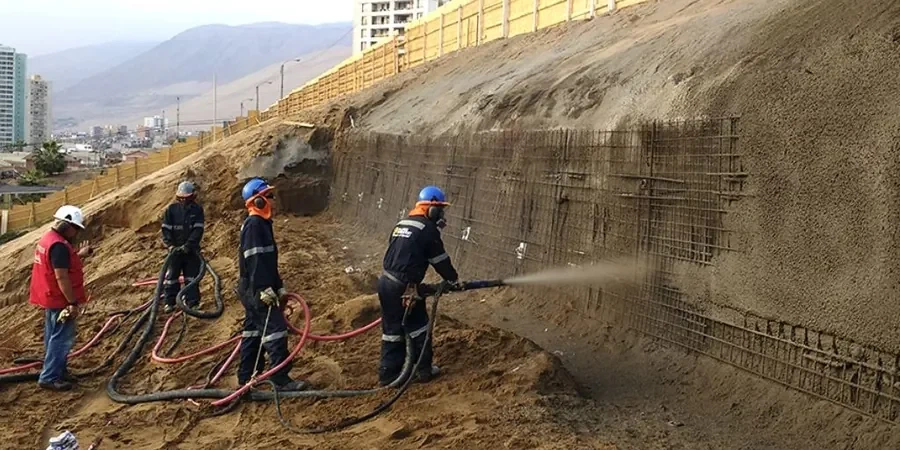
A 45-foot-high cut slope for a warehouse complex off the 215 freeway failed during construction last year. The contractor had benched it at 1.25:1 without considering the weak claystone layer at 12 feet depth. Three days of heavy rain turned that layer into a sliding plane. We were called in to analyze the failure. Using residual shear strengths from ring shear tests and back-calculation, we determined the pre-failure FoS was 0.92. The repair required a 40-ton soil nail wall combined with horizontal drains — a $380,000 fix that could have been avoided with a proper stability analysis at the design stage. Riverside’s varied geology makes this kind of incident more common than most developers realize.
CD triaxial (ASTM D7181) or direct shear (ASTM D3080)
Seepage model
Steady-state SEEP/W or transient for storm events
Slip surface search
Auto-grid search + entry/exit zones
Complementary services
01
Limit Equilibrium Analysis (LEM)
Two-dimensional analysis using Bishop and Spencer methods for circular failures. Includes sensitivity runs on cohesion and friction angle. Suitable for residential subdivisions and commercial pads. Delivered with cross-section plots and FoS tables.
02
Finite Element Slope Stability (FEM)
Strength reduction method in Plaxis 2D. Captures progressive failure, stress concentrations, and soil-structure interaction. Recommended for large cuts near existing foundations or where deformations are critical. Includes displacement contours.
03
Seismic Slope Stability (Pseudo-Static / Newmark)
Pseudo-static analysis with horizontal seismic coefficient kh = 0.15g per ASCE 7. For critical slopes, we run Newmark sliding block analysis to estimate permanent displacement. Includes site-specific response spectrum from VS30 measurements.
How deep do you need to investigate for a slope stability study in Riverside?
Boring depth should extend at least 5 feet below the deepest potential failure surface, or to refusal on competent bedrock. For a 30-foot cut in Riverside's alluvium, we typically drill to 40-45 feet. This ensures we capture weak layers like paleosols or old stream channels that can control the slip surface.
What Factor of Safety does Riverside County require for cut slopes?
Riverside County grading ordinances follow CBC 2019: minimum static FoS of 1.5 for permanent slopes and 1.3 for temporary excavations. Seismic pseudo-static FoS must be at least 1.1. These values apply to both circular and non-circular failure modes. Our reports explicitly state the FoS for each mechanism.
How much does a professional slope stability analysis cost in Riverside?
For a standard residential lot with one cross section, expect between US$1,120 and US$2,400. Larger commercial projects with multiple sections, FEM modeling, or seismic analysis range from US$2,800 to US$4,220. The variation depends on number of borings, lab testing volume, and complexity of groundwater modeling.