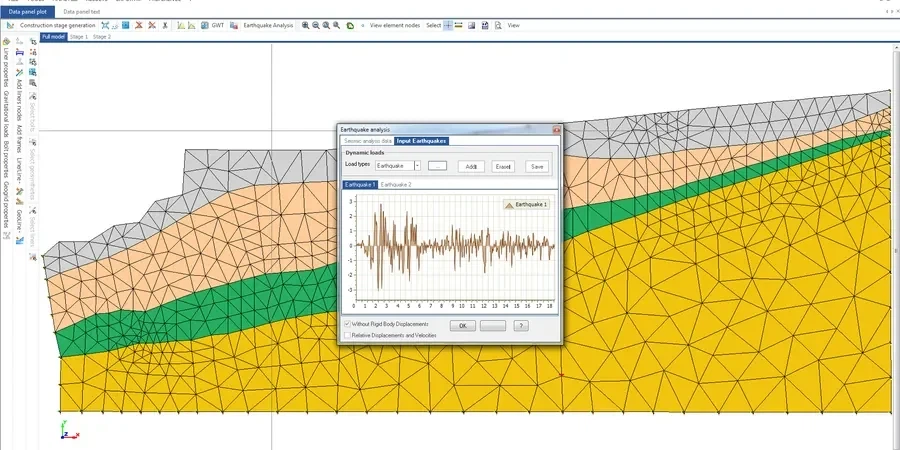
Riverside sits in the Inland Empire, where the Santa Ana River basin meets the San Jacinto fault zone. The region's alluvial fans, deep sedimentary deposits, and variable groundwater create a complex seismic setting. For any structure requiring code compliance, a proper site response analysis is the first step to understanding how local soils will amplify or dampen earthquake shaking. We combine downhole seismic testing and MASW surveys to capture shear wave velocity profiles that feed directly into your design parameters. Before we deploy geophysical arrays, we often run a MASW/VS30 survey to map stiffness variations across the site, especially where fill or paleochannels are suspected.
Riverside's alluvial fans and fault proximity demand site-specific amplification factors, not generic code maps. A one-size-fits-all approach can miss localized basin effects.
Method and coverage
Riverside's expansion from citrus groves to a metro area of over 300,000 people has buried old channels, terraces, and even landfill zones under pavement. Each of those buried features has a different stiffness and liquefaction potential. Our site response analysis accounts for this buried history by integrating borehole logs with shear wave data. The workflow follows ASCE 7-22 site classification (A through F) and uses the NEHRP provisions to compute spectral accelerations. A key input is the time-averaged shear wave velocity to 30 meters (VS30), which we obtain through both invasive (downhole) and non-invasive (MASW) methods. Where liquefaction is a concern, we couple the analysis with a liquefaction hazard assessment to estimate post-shaking settlement.
Technical reference image — Riverside
Regional considerations
The biggest risk in Riverside is not the shaking itself — it's assuming the ground will behave uniformly. The city straddles multiple geologic units: young alluvium near the river, older terrace deposits on the benchlands, and weathered bedrock on the hillsides. A site response analysis that treats the whole parcel as one soil column can miss resonance effects where soft layers overlie stiff strata. We deploy geophysical arrays (MASW, ReMi, downhole seismic) to capture 2D and 3D variability. Our team flags zones where the fundamental site period matches building resonant periods — a condition that can double spectral demand if ignored.
What is the difference between site response analysis and standard soil boring?
A standard soil boring provides stratigraphy and strength parameters, but it does not capture how seismic waves propagate through the soil column. Site response analysis uses shear wave velocity profiles and dynamic soil properties to compute amplification factors, resonance periods, and acceleration time histories at the ground surface. It is essential for structures where code-based site class maps may be too conservative or too unconservative.
How much does a site response analysis cost in Riverside?
Typical costs range between US$1,420 and US$4,600 depending on site complexity, number of testing locations, and depth of profiling. A simple site classification (MASW only) sits at the lower end, while a full hazard analysis with downhole seismic and liquefaction assessment approaches the upper range.
What site classes are most common in Riverside?
Along the Santa Ana River and its tributaries, Site Class D (stiff soil, VS30 180–360 m/s) dominates. On the benchlands and older alluvial terraces east of downtown, Site Class C (very dense soil/soft rock, VS30 360–760 m/s) is common. The box springs area and hillsides near the San Jacinto fault can reach Site Class B (rock). A site-specific analysis is the only way to confirm the correct class.
Do I need site response analysis for a low-rise building in Riverside?
Yes, if the building is in Seismic Design Category D, E, or F — which covers most of Riverside per IBC 2021. Even a two-story structure on soft alluvium can track record significant amplification if its natural period aligns with the site period. The 2021 IBC requires site-specific ground motion procedures for certain structures on Site Class E or F, and for buildings with irregular configurations. Always check with the local building department.